

DUŠAN MARTINČEK (1936–2006), an important Slovak composer, pianist and teacher, was one of the musicians whose activities were closely linked to the key personalities of the Slovak music from his youth. He was born in Prešov, where he spent his early childhood, dedicated himself to piano playing and began to compose as an eight-year-old lad. When he was ten, his family moved to Bratislava, where he continued to study music, initially as a private pupil of Rudolf Macudziński, Alexander Albrecht and Ján Zimmer. Besides, as he himself stated, “in the wide realm of arts I was, in fact, a pupil of Ján Albrecht”, with whom he became friends in Albrecht’s House, and who “discreetly introduced me not only to the mysteries of music, but also of aesthetics and fine arts” (Martinček). At first he studied piano playing at the State Conservatory (Anna Kafendová), and soon he had a few of his own piano pieces to his name. He continued his studies at the Academy of Performing Arts in Bratislava as a pupil of Rudolf Macudziński in piano playing and Ján Cikker in composition, and graduated in 1961. Active as a piano soloist and composer, he nevertheless did not neglect chamber playing; he was famed for his excellent competence in sight-reading.
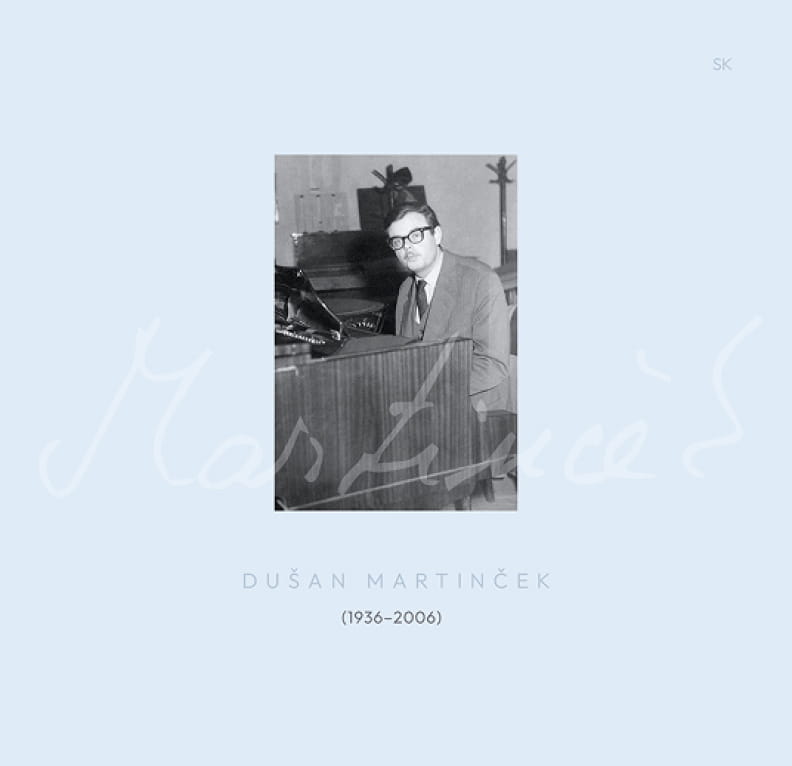
Martinček’s composition studies culminated with the work Dialogues in the Form of Variations for Piano and Orchestra, and as a composer he was considered “as unusually gifted and modest ..., joining Scriabin and Bartók, as well as Lisztian and Chopinian elements, which he, in a very interesting way, transformed into his peculiar and sometimes unusually distinctive style” (Cikker). Soon Dušan Martinček “grew into an artistic personality of a remarkable importance nationwide” (Cikker). Later he taught at the Academy, where he was appointed Professor of Composition in 1993; several international awards followed. Still he remained faithful to his highly individual approach to teaching in the spirit of the Albrechtian tradition. Many of his students recall numerous meetings and inspiring discussions in the domestic ambience of his flat in the Dúbravka district in Bratislava.
Martinček’s musical output embraces over a hundred compositions. Music for piano dominates, and in addition to his chamber and orchestral music he dedicated himself to guitar composition ardently, a rarity in our territory. His piano music, in which he excelled, culminated in solo sonatas written at the turn of 1980s. In the author’s words, they represent “atotally new universe” and an initial stage to his later work in which he purposely broke away from the dominance of piano texture. He focused on chamber and orchestral works and devoted himself to his new musical hobby – guitar playing. His activities resulted in an output spanning a variety of genres not lacking string quartets, quintets, orchestral works and a number of guitar pieces. Martinček’s musical language is characterized by a search for balance which would offer him “enough liberty for his work”. Although he was clearly immersed in tradition, he never avoided any modern compositional devices. By this his language absorbed contrasting elements ranging from the music of Renaissance, through Romanticism, to serial techniques to aleatorics. In addition to Beethoven, he considered Scriabin his model, with whom he had in common “inclination to dreaming and tendency to the fantastical and the mystical”. Simultaneously an idea that “not the technique but mainly the content should be the primary aspect of the work” became his motto.
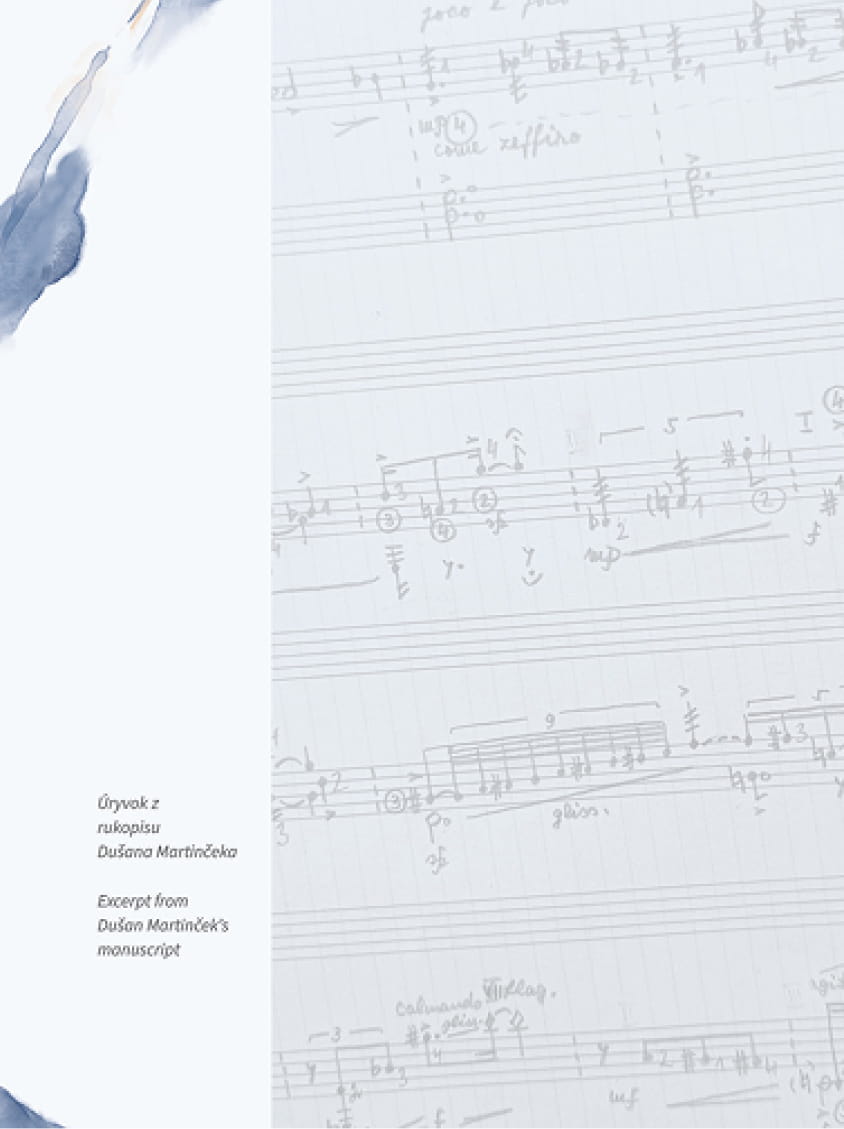
In the context of the 20th century Slovak music Dušan Martinček’s guitar work is a unique phenomenon from various aspects. His interest in guitar is linked to the period of 1980s, when the composer endeavoured to break away from piano thinking which he felt as an “unbearable burden inhibiting my imagination” (Martinček). The distinction of guitar texture which he came to know through the study of guitar repertory of various periods, as well as through the practice in playing the instrument, may have been that important impulse for overcoming the limits of piano thinking within which he had been living and composing since his childhood. Also his close friend Jozef Zsapka, a renowned guitarist and teacher, became a strong inspiration for him; he dedicated the majority of his guitar works to him.
Unfortunately, from Martinček’s first series of pieces for solo guitar Prélude, Sérénadé, Intermezzo, Tarantella (1982), only the first two were published (OPUS, 1984). The composer’s continuous endeavour to compose for the young unquestionably contributed to his coping successfully with the guitar texture. First 7 Studies (1983) were followed by the cycle Performance Pieces for Young Guitarists (1983) and a very popular series Gradus ad Parnassum (1985). Not only does the former cycle hone the technical skills of young guitarists, it also charmingly broadens their musical horizons through recognition of styles and musical forms present in the history of music (Trouvere’s Song, Song without Words, Valse Triste, Cake-Walk ...). In the latter we can find impressive characteristic miniatures (We Got Lost in Woods, Merry Pilgrim, A Clumsy Dancer, Night Shadows ...). In these Martinček succeeded in following up on his predecessors Albrecht and Cikker and his didactic cycles became a guitar counterpart to their piano literature for the youth. In contrast to the musical language present in Martinček’s guitar music for the youth, there are several compositions more conspicuously breaking with tradition and following his modernist tendencies. This inclination revealed itself as early as in Prelude from the first series of pieces (1982) and it is also apparent in his Fantasia and Ostinato Dance from 1985, and Prelude (No. 2) from the same period.
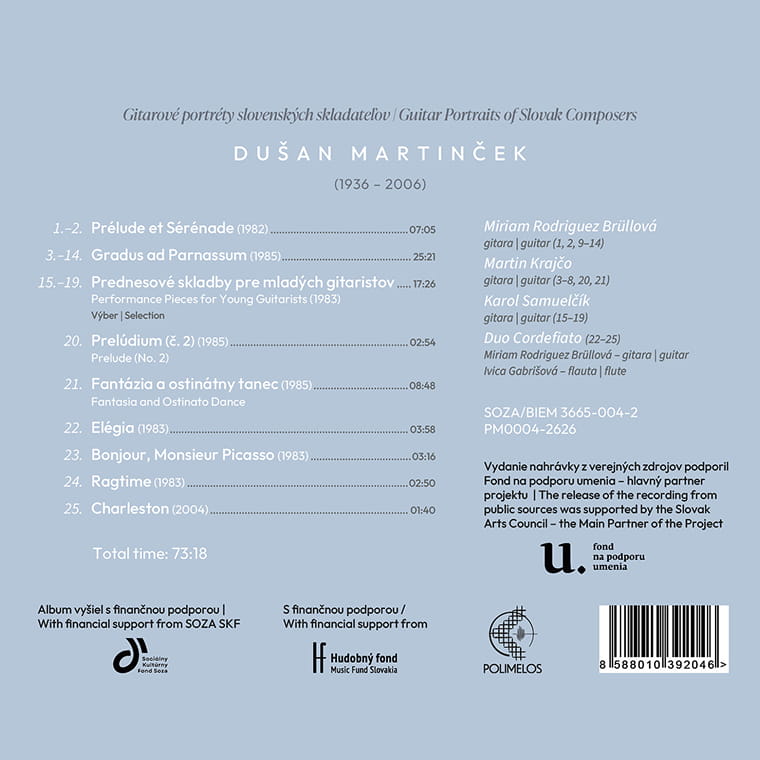
A separate chapter of Martinček’s work is a foursome of pieces for flute and guitar. Their origination is linked to the mastery of the internationally renowned duo Dagmar and Jozef Zsapka, who became most ardent disseminators of Martinček’s work both in Slovakia and abroad. Bonjour, Monsieur Picasso, Elegy and Ragtime were all written in the beginnings of the composer’s guitar composition, and the first two of them were premiered at the international festival Days of Guitar Music in Bratislava in 1985. The first one is a tribute to Picasso and presents a connection between Spanish idioms and efforts in the highest utilization of the dispositions of the instrument, accentuating the potential of flute as an instrument rich in specific effects and technical nuances. No wonder the piece became an especially successful “number” of concert programmes. His Ragtime was described by Dagmar Zsapková as “an encore which does not solve any problem, raises a smile and leaves joyous feelings”. The contrasting Elegy “consciously uses their mutual human interconnection and its own capacity for emotional expression in a minimal space” (Zsapková). The last of the four pieces for flute and guitar and simultaneously the compositional full stop to the whole creative work by Dušan Martinček is Charleston from 2004. Once again, it is a merry piece filled with positive emotions, which the composer dedicated to Duo Cordefiato, a pair of outstanding Slovak artists Miriam Rodriguez Brüllová and Ivica Gabrišová.


