It was in 1797 when Friedrich Schlegel started up the review Athenäum, which in the threeyears of its existence became aliterary institution for early Romanticists. The opening Fragments formulated the principal ideas concerning the poetics of Romanticism. In addition toother thoughts they furthered the integration of not only all poetic elements, but also ofphilosophy, rhetoric and critic. They declared that “its goal is not merely to unite all independentpoetic genres but also to link poetry with philosophy and rhetoric...” By adopting as manyrealms of life as possible, the universal poetry transforms life itself into poetry and “for art it isthe same as joke is for philosophy, and society, friendship and love are for life”.
Today perhaps the most renowned author setting Romantic poetry to music is Franz Schubert, who succeeded in merging flawlessly the worlds of literature and music in his songs and presenting it all live at soirées called Schubertiades. The songs originated in the period of Viennese Biedermeier, which in 1815 superseded the difficult era marked by Napoleonic wars. It was a climate especially favourable to arts development in community ambience. People grouped in various associations and circles integrated their artistic skills, professional artists collaborated with dilettanti in artistic productions, which encouraged the origination of a unique form of collective creativity. Domestic music-making bloomed which reflected especially in the field of solo and chamber music, and above all in a new popular song genre in German language, the Lieder. Although Schubert had already written several impressive works of this kind at the age of only 21, he was not known in Vienna as a song writer yet. This changed in 1821 when the Viennese publisher, composer, pianist and guitarist Anton Diabelli decided to publish them. The songs originated from 1814 until Schubert’s death; at least six hundred of them are known and they set to music the poetry of Goethe, Müller, Rellstab, Körner, Heine, Seidl, Mayrhofer and the already mentioned Schlegel. An essential aspect of Schubert’s song work is the subject of nature. Natural elements become the central topic of his songs, we can find various parables in them, and in particular one central motif which is the retelling of an experience of a person’s encounter with the mostly idealized natural world.
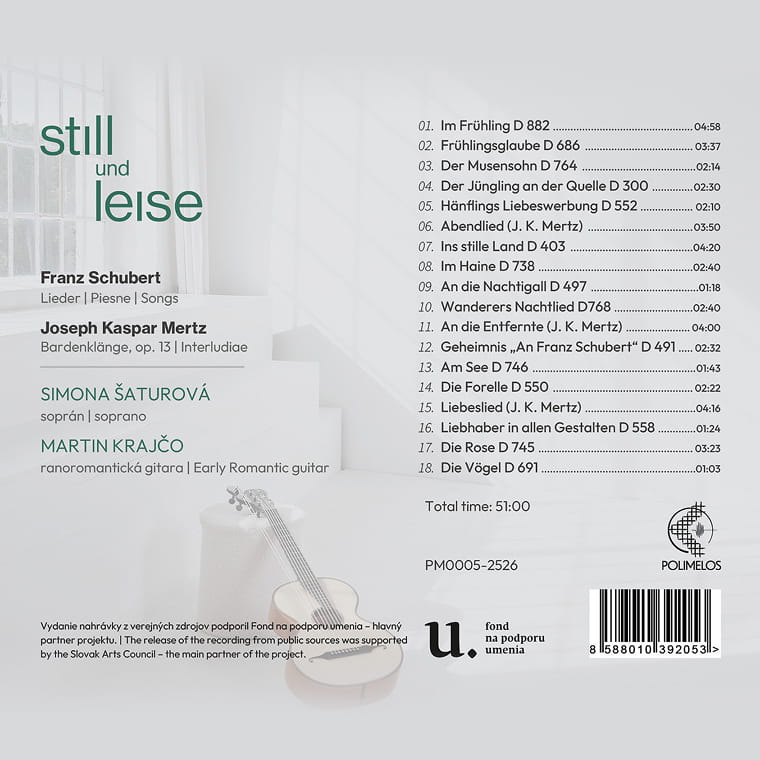
Reflecting the conditions of the then musical practice, Schubert’s songs were published not only with piano accompaniment, but also with guitar accompaniment. The usage of guitar as an accompanying instrument was conditioned by several factors. It was usually readily available in artistic circles, which was linked to the environment in which the music productions took place. Besides chamber spaces, salons, it was often the outdoors, where its portability was crucial. In addition to Diabelli, we can find names such as Joseph Wanczura, and the Pressburg-born composer and guitarist Franz Pfeiffer among the composers who provided songs with guitar accompaniment. During Schubert’s life dozens of his songs were published with guitar accompaniment in Vienna. The frequent usage of guitar is also documented by a manuscript collection of the lawyer and poet Franz von Schlechta, who was Schubert’s close friend. After Schubert’s death the interest in guitar arrangements of the originally piano accompaniments persisted and Pressburg virtuoso Joseph Kaspar Mertz wrote them too. The original piano texture in Schubert’s songs often comprises guitar idioms like arpeggio figures and chord inversions typical for guitar; therefore songs with guitar accompaniment sound as natural as they do in their original form. In this context, the period arrangements transforming the accompaniment within the natural character of the instrument with a goal not to divert the attention from the dominating lyrics, appear ideal.

Poetics of nature and “wandering” is also typical for “Ossianic” poetry which became the model for several opuses by Romantic composers, as well as for the most beautiful Early Romantic guitar cycle Bardenklänge by J. K. Mertz. The origination of majority of the cycle’s books entwined with Mertz’s interest in Schubert’s songs, which also metamorphosed into their guitar arrangements. In his cycle Mertz presents the universality of his work, and linking to the heritage of piano music of Schubert, Schumann and Mendelssohn, he surpasses his guitar contemporaries in many ways.